


SoFi Stadium steals the show at World Cup

Arash Markazi
Host · Writer
INGLEWOOD, Calif. — The biggest star of the World Cup group stage doesn't wear a jersey. It doesn't have a nationality, a squad number or a left foot. It's a building.
It's a $5 billion spaceship that touched down in Inglewood six years ago, and over the past two weeks it has quietly reminded the planet of something Angelenos have known ever since it opened. The best stadium in the world resides in Inglewood, California. SoFi Stadium has arguably been the biggest winner of this World Cup, not because it was awarded the biggest match, but because every game it has hosted has reinforced what makes it unlike any venue on Earth.
Thursday's group stage finale between United States and Türkiye was played before another sold out crowd of 70,492 as they watched Türkiye win, 3-2, on a last second goal in extra time. The result didn't change the fact that United States won Group D and Türkiye was eliminated but it continued to drive home why SoFi Stadium has been the best venue during the World Cup.
One of the biggest winners of the World Cup is SoFi Stadium. It looks absolutely amazing in-person and on television. Everyone I’ve talked to thinks it should have been the home of the final. pic.twitter.com/7IKDHRgcKF
— Arash Markazi (@ArashMarkazi) June 26, 2026
Start with the opener. The United States dismantled Paraguay 4-1 before a sellout crowd that, much like Thursday's group stage finale, featured more stars than the Academy Awards but unlike the Oscars, nobody left early. The building shook from kickoff to the final whistle. The Americans announced themselves as contenders, and television cameras lingered almost as long on the translucent canopy and the massive Oculus video board as they did on the action unfolding below. The venue itself became part of the broadcast, impossible to ignore even during the biggest sporting event in the world.
Then came the heavy one. Iran and New Zealand played to a 2-2 draw filled with politics, history and emotion, the kind of match that reminded everyone why the World Cup is different from every other sporting event. SoFi somehow managed to hold all of it without spilling a drop. Stadiums can be loud, but the truly great ones also know when to go quiet, when to let 70,000 people collectively hold their breath and allow a moment to resonate. This one did, turning a soccer match into something that felt much bigger than the scoreline.
Last Thursday's noon kickoff should have been the exception. A workday afternoon match between Switzerland and Bosnia and Herzegovina didn't exactly scream marquee attraction, particularly in Los Angeles, a city famous for arriving late. Instead, by 11 a.m., nearly an hour before kickoff, the stadium was already full. Switzerland went on to win 4-1 before 70,026 fans who celebrated every goal as if the Rams had just won another Super Bowl. It was another reminder that the attraction wasn't simply the teams on the field. People wanted to experience this stadium during a World Cup.
And it didn't stop there. More than 70,000 fans packed SoFi Stadium on Sunday for Belgium against Iran in one of the tournament's most emotionally charged matches. Four days later, another sellout watched the United States take on Türkiye in an atmosphere that felt more like a knockout match than the conclusion of the group stage. Every crowd seemed louder than the last. Every match somehow topped the one before it. By the end of the group stage, SoFi Stadium had hosted five matches, and every one of them felt like an event worthy of the global stage.
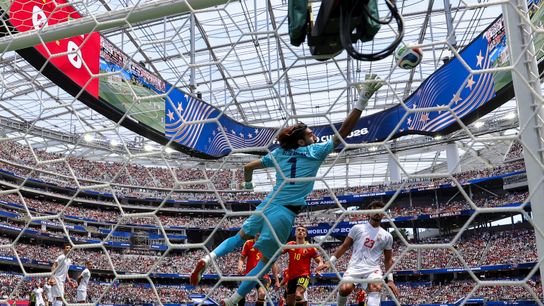
Jordan Teller – The Sporting Tribune
Alireza Beiranvand #1 of Iran dives for the ball during a 2026 FIFA World Cup match against Belgium, Sunday June 21, 2026 in Inglewood, Calif.
So here's the part that still makes no sense after watching five World Cup matches in Los Angeles.
SoFi Stadium will not host the World Cup final.
That honor went to MetLife Stadium, a perfectly respectable venue in New Jersey that will spend July 19 pretending to be the center of the soccer universe. SoFi won't get a semifinal, either. Those went to AT&T Stadium in Arlington and Mercedes-Benz Stadium in Atlanta. The most spectacular stadium ever built was handed a quarterfinal and told that should be enough, even though every match it has hosted has strengthened the argument that the tournament's biggest stage should have been right here.
There's simply no stadium quite like SoFi. The translucent canopy transforms daylight into something cinematic, while the Oculus, the massive dual-sided halo video board suspended above midfield, has no equal anywhere in sports. Pull up any photograph from the past two weeks and it hardly looks real. The images resemble an architect's rendering or a scene from a futuristic video game more than a sporting event. Then you walk through the gates, look up for the first time, and realize the photographs actually undersell the experience.
That's the inconvenient truth about SoFi Stadium: the hype doesn't do it justice. Most stadiums spend years trying to live up to impossible expectations. SoFi somehow exceeds them. Visitors arrive expecting to see one of the world's great venues and leave wondering how anything else could compare. The building isn't simply impressive because it cost $5 billion. It's impressive because every design choice serves the fan experience, whether you're sitting in the front row or the upper deck.
The World Cup wasn't SoFi's arrival. It has hosted big events before. But this was the warm-up act to an unprecedented two-year run.
The building was constructed as the home of the Rams and Chargers, but what it has become is something much larger than an NFL stadium. In February 2027, SoFi will host Super Bowl LXI, its second Super Bowl in just five years, something no venue has ever done. A year later, it will share the Olympic opening ceremony with the Los Angeles Memorial Coliseum before transforming into the world's largest swimming venue, where an Olympic pool will sit on the same field that hosted these World Cup matches.
World Cup. Super Bowl. Olympics. Three of the biggest sporting events on Earth in the span of two years. There is no other stadium that can make that claim.
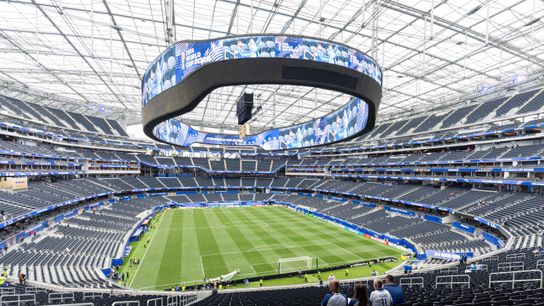
Jordan Teller – The Sporting Tribune
A general interior view of SoFi Stadium before a 2026 FIFA World Cup match between Switzerland and Bosnia and Herzegovina, Thursday June 18, 2026 in Inglewood, Calif.
The stadiums in Arlington, Atlanta and New Jersey will get their marquee matches this summer, and they'll do just fine. The world will celebrate a champion there, take its pictures and move on to the next tournament. SoFi doesn't need the World Cup final to validate what it is. If anything, the tournament has only highlighted what everyone who has walked through its gates has already concluded. It's playing a much longer game, and it's already winning.
But every coronation comes with a catch: almost nobody can afford to attend it. The get-in price for Switzerland against Bosnia and Herzegovina hovered around $600. Belgium against Iran pushed toward $1,000. The United States against Türkiye topped $2,000 before parking or concessions. Those weren't knockout matches or a semifinal. They were group-stage games, and they turned the most beautiful stadium in the world into the hottest ticket in sports.
Which also means the people who live closest to it are often the least likely to experience it. Families in Inglewood watched this stadium rise above their neighborhoods. They lived through years of construction, traffic, cranes and rising rents that came with its arrival. Yet many have been priced out of the biggest events taking place in their own backyard. The stadium looks magnificent on television. For too many of the people who call Inglewood home, that's the only place they'll ever experience it.
For now, though, SoFi is getting its flowers from fans who traveled from Tehran, Auckland, Bern, Sarajevo, Brussels and across the United States expecting to watch a soccer match and leaving talking about the building instead. That's what happens when a venue becomes more than a place to stage an event. It becomes part of the story itself, another character in the tournament that people remember long after the final whistle.
The World Cup will crown a champion in New Jersey next month, and history will forever record that as the site of the 2026 final. But anyone who experienced this tournament in person knows where its defining venue was. It's standing in Inglewood beneath a translucent roof, illuminated by the largest video board ever built, quietly reminding everyone who walked through its gates that sometimes the stage becomes the star. SoFi Stadium never needed the World Cup final to prove it was the world's greatest stadium. The group stage already did.